Abstract
Misogyny in Esports
Esports is typically praised as a space where anyone with excellent mechanics, game sense, and passion can rise to the top. This makes Esports quite different from traditional sports as it completely eliminates the physical element of it, which aids in creating a sense of fairness between every competitor. This perception of esports is what has helped it grow into a global industry with millions of players and spectators, with millions of dollars poured into it year after year. However, this value of fairness in Esports cannot be said for women as for them, participation in esports is not just about competition but also about navigating harassment, harmful stereotypes, and exclusion that influence how they are treated and how they engage with the community.
The communities that I observed for this study include competitive multiplayer games which I already play like Overwatch, Marvel Rivals, and Valorant, along with Twitch streaming environments and the related social media spaces. These platforms rely typically on communication, particularly voice chat, where players can discuss strategies and build teamwork amongst each other. The problem is that this same communication system exposes harmful social dynamics, especially gender bias. These are based on usernames, voice interactions, and presentation of oneself, these spaces are predominantly male. I consistently saw that the tone of chat interactions switched when a female player spoke. Conversations that were previously neutral often turned dismissive or hostile, with female players immediately questioned about their skill level through comments like “Are you actually good?” or “Don’t throw.” (throwing means you’re doing nothing to help win the game). In contrast, all male players are generally assumed to be decent unless proven otherwise. This pattern shows how women must earn credibility, while men do not need to worry about this at all, which reveals an immediate problem in how players are seen.
Language plays a large role in reinforcing this bias. While esports communication is generally aggressive and competitive, it instantly becomes distinctly gendered when directed at women. Female players are frequently interrupted, talked over, or given non needed advice regardless of their performance, I typically noticed that when women would try to discuss a play or strategy to set up in matches they would get shut down or people would just not listen, even if the play was a good call. The tone of communication often shifts away from strategy and toward personal identity, with comments that are usually hostile. For example, instead of calling female players by their usernames or by the character their playing (there are people who simply call players by their characters as its just easier than calling them by their usernames most of the time as some people have strange usernames), teammates may refer to them using gendered terms like “women” showing a lack of respect. Additionally, performance is interpreted through a gendered lens, mistakes are chalked up to being a female, while success is treated as an exception. This double standard causes a harmful situation where women are judged more harshly and don’t receive the full acknowledgement for their skill, which a man would typically get if they did the same thing. Research supports these observations, as studies have shown that female players are often thought of as less competent regardless of their performance, showing how bias is embedded deeply in the culture rather than based on an individual’s ability (Nyugen et al.).
One of the most significant consequences of this environment is identity hiding. I have noticed that many female players just choose to avoid voice chat or create usernames that wouldn’t indicate that they’re female to prevent themselves from harassment. While talking with some female friends who play games at casual and competitive levels, some of them explicitly stated that speaking was “not worth the harassment,” and “it just becomes exhausting” indicating that being silent becomes a protective strategy. While this allows women to participate without instantly being targeted, it also strengthens their invisibility within the gaming community and adds to the idea that esports are mostly a male thing. Kim and Kim discuss this as a social process in which women feel the need to change their behavior to avoid discrimination rather than fight it directly. This dynamic shifts the burden onto individuals instead of looking at the harmful culture which ultimately maintains inequality. The lack of visibility also limits the possible opportunities for recognition and advancement. This is because communication is quite essential for both teamwork and creating a presence within the community.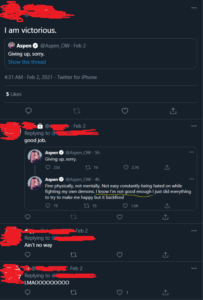
The experiences of the very popular streamer Aspen show how gender bias operates in highly visible spaces. Aspen is a top ranked Overwatch player who was extremely talented; she once tried to go for rank 1 on the leaderboards (this means being the highest rated player in the world) which was well within her ability as she was super good at the game. She did not know at the time however that she faced targeted harassment from other pro players who would queue snipe her which means they would try to get on her team in matches so they could throw her game so she would not get rank 1. Even with this happening she still got to rank 1 as she was just that talented. Even with her reaching rank 1, people undermined it because it was done using support characters like Mercy which is seen as a character only women play and seen as a character people play to get carried (being carried means your team did everything for your win while you did little.). She got tired of people saying this so she went and hit rank 1 again but using characters like Lucio and Baptiste reaching a 4700 rating peak which is an extremely impressive rating that even most pro players wouldn’t be able to hit. All of this drama and negativity had a large impact on her because after hitting this peak she stopped competing in esports since she had to deal with so much toxicity for simply being women. Her leaving the competitive scene demonstrates how sexism can go beyond verbal harassment into actions that directly disrupt competitive progress as talked about in a Dexerto article (Dexerto). Aspen has also shared publicly about the emotional toll that was caused because of this negativity, noting that it is “not easy constantly being hated on,” a statement that reflects the psychological impact of continued harassment. The picture above shows a person being happy that Aspen gave up on her goals. Her experience shows that visibility does not eliminate bias; instead, it just intensifies it. As a public figure, she becomes a target for a wider audience, amplifying both support and harassment. This creates a strange paradox in which success increases exposure but also increases vulnerability like with the queue sniping and such, making it very difficult for women to stay involved in esports spaces even at the highest level.
A similar dynamic is evident in the case of Aramori who is a Marvel Rivals professional player, who has spoken out about sexism within competitive gaming. Aramori highlights incidents such as the sabotage of female players and emphasized that sexism is widespread across nearly all esports communities. The reactions to these statements reveal a divided culture, while some players acknowledge and support these claims, others dismiss or make them seem like they’re not a problem. This divide reflects a resistance to recognizing gender bias as a systemic issue. Social media platforms like X play a key role within these discussions, functioning as extensions of esports communities where players share experiences and challenge narratives. However, they also expose people to more criticism, demonstrating how efforts to address inequality can be met with backlash. Aramori’s case underscores the difficulty of creating large change in an environment where even acknowledging the problem exists is contested.
These patterns are supported by existing research on esports and gender inequality. Kim and Kim argue that male dominance in esports is maintained through many social processes that normalize behavior which pushes others away (Kim and Kim), while Groen suggests that initiatives such as female only tournaments may provide opportunities but can also create and strengthen separation rather than integration of women (Groen). Together, these perspectives highlight a large contradiction within esports culture, although the industry promotes inclusivity and equal opportunity, everyday interactions often just put down these values, it’s like moving two steps forward and two steps back. Harassment and bias are so normalized to the point where they are seen as just a part of the competitive environment that is normal rather than problems that require change. This is super scary in my opinion because people are becoming so comfortable with attacking people and putting other people down because they’re women. Gaming is seen as an escape from the many problems life has for lots of people, sexism being one of them and if people can’t feel safe from harassment in the very thing they dive into to feel safe then what even is the point anymore. This creates limited representation and lack of institutional support which further leads to creating a nasty cycle that discourages female participation and maintains the inequality.
As someone who participates in gaming communities, observing these patterns over time changed my perspective immensely. What initially seemed like incidents of toxicity which happened once in a blue moon became clearly identifiable trends which occur heavily that point to a deeper cultural issue. This realization also raised questions about my own role within these spaces. There were moments when I witnessed harassment but sadly did not intervene, highlighting the difficulty of addressing harmful behavior in real time and the ways in which passive observation can also contribute to the problem. This tension reflects a broader challenge within esports, meaningful change requires action from every single person, even then there are many participants who remain not involved in something that they should be involved in and do not do what they can to allow stuff like this to no longer happen or at least happen less. Future research could explore how developers and platform moderators might reduce harassment without taking away from the competitive nature of these environments, as well as whether increased visibility for female players would lead to greater inclusion or intensified backlash. There have been efforts from games like Marvel Rivals and Call of Duty to create a safer voice chat by using AI and incorporating misuse of the voice chat within the report system but these just are not enough as there are many work arounds to these systems.
In conclusion, esports presents itself as a fair and skill based space where anyone can positively shine but through analysis of the community we see that systemic gender bias continues to shape the experiences of female players. Harassment and identity hiding are not isolated issues but are deeply instilled aspects of the culture which cause limited participation and reinforce underrepresentation of women within esports. The cases of Aspen and Aramori show that these challenges occur largely across both the casual and professional level, affecting even the most skilled and visible individuals of the community. Lack of women representation in esports is not due to a lack of skill or interest but instead are the result of disruptive systemic barriers that take away from engagement and success. Addressing these issues will require more than just acknowledging their existence though, it needs constant efforts made to challenge the harmful norms and create an environment where all players can finally compete on truly equal terms and feel accepted.
Works Cited
Kim, Se Jin, and Youngsun Sean Kim. “Gender Inequality in eSport Participation: Exploring the Social Process of Women eSport Consumers.” Journal of Sport Behavior, vol. 45, no. 4, Dec. 2022, pp. 79+. Gale Academic OneFile, link.gale.com/apps/doc/A743647618/AONE?u=cuny_ccny&sid=bookmark-AONE&xid=09486c 63. Accessed 30 Mar. 2026.
Groen, Maike. “(Un)Doing Gender? Female Tournaments in the E-Sports Scene.” International Journal of Gaming and Computer-Mediated Simulations, vol. 8, no. 4, Oct. 2016. Gale Academic OneFile, dx.doi.org.ccny-proxy1.libr.ccny.cuny.edu/10.4018/IJGCMS.2016100102 . Accessed 30 Mar. 2026.
Nguyen, David Van, Edward F. Melcer, and Deanne Adams. “Exploring Gender and Racial/Ethnic Bias Against Video Game Streamers: Comparing Perceived Gameplay Skill and Viewer Engagement.” Proceedings of the 19th International Conference on the Foundations of Digital Games. 2024. Exploring Gender and Racial/Ethnic Bias Against Video Game Streamers: Comparing Perceived Gameplay Skill and Viewer Engagement
Dexerto. “Male Overwatch Pros Accused of Throwing Games with Female Players then Bragging.” Dexerto, 2024, www.dexerto.com/overwatch/male-overwatch-2-pros-accused-of-throwing-games-with-female-players-then-bragging-2303010/.

This entry is licensed under a Creative Commons Attribution-NonCommercial-ShareAlike 4.0 International license.

